
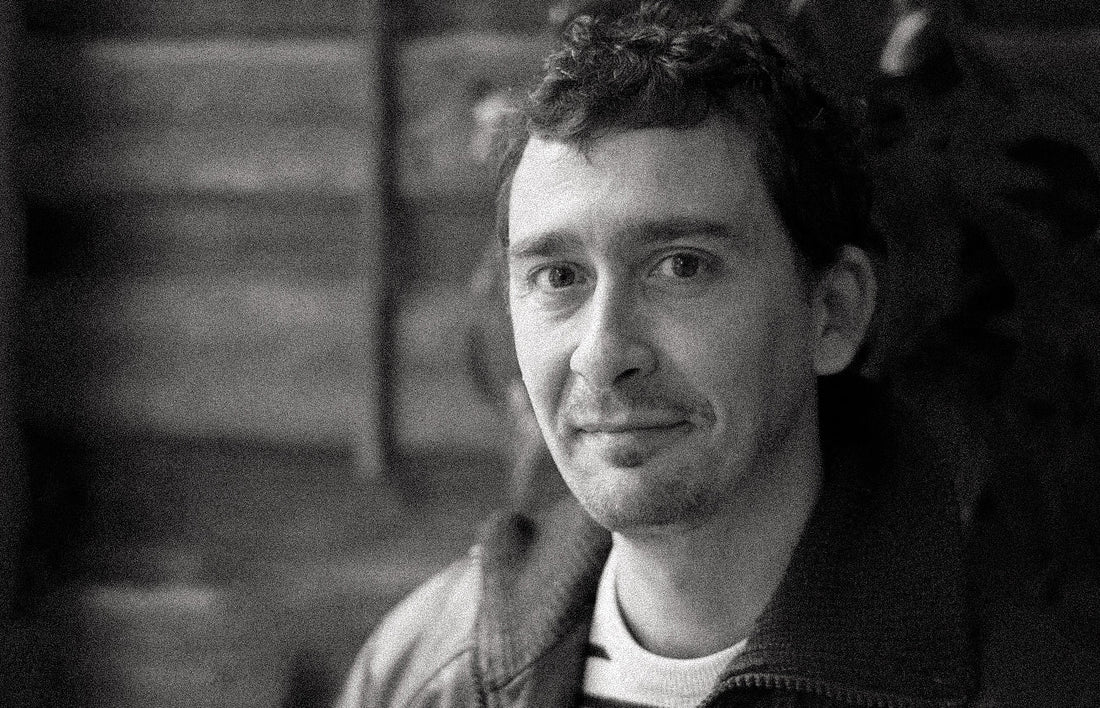
Andrea Copetti of Tipi
There is a quiet magic in the books that find us through the hands of another. A friend. A parent. A bookseller who has come to know the rhythm of your reading life. Who sets something aside without a word, certain it will speak to you in just the right way. The finest booksellers have this gift. Not a trick, but a kind of listening. As if they can feel the current beneath the words, and sense where it might carry you.
We spoke recently with Andrea Copetti of Tipi Bookshop. A bookshop that, like all the truly great ones, feels less like a store and more like entering someone’s inner world. A collection made not by category, but by care.
S/B: What was the first book you remember buying?
AC: The first book I remember buying was Self-Portraits by Lee Friedlander. It struck me deeply when I was a young photographer, mostly because at the time, I only had myself as a subject. Discovering that someone, decades earlier, had turned the camera on himself, his own body, while exploring shadows and visual composition, was a revelation. It made me realize: this is what I want to do with my life, and this is the medium I want to explore.
SB: What role do you think independent bookstores like Tipi play in shaping a city’s creative community?
AC: Independent bookstores like Tipi play a cornerstone role in a city’s creative community by helping people slow down. When you step into a place like Tipi, yes, you might start by taking pictures of the books, but slowly, minute by minute, you begin to feel something else. No one is asking anything of you. Tipi isn’t trying to sell you an experience, it’s offering you quality time. It’s giving you a kind of credit of time. And in that space, surrounded by 2D works presented as 3D creative objects, you give yourself permission to reflect, on other people’s experiences, on local creatives in Brussels, or on voices from the international scene. That’s a rare and valuable thing in a city, and something that sets places like Tipi apart.

SB: Owning a bookstore is truly a labour of love, what drives you to open up every morning?
AC: The simple fact that I never know who I’m going to meet. It might sound arbitrary, but it’s true, I can have a whole day filled with people I know, but more often it’s people I’ve never met, never seen, never heard of. And by the end of the day, what keeps me excited for the next one is all those encounters, with creatives, collectors, or just people who love images, even if they’re not necessarily into the kind of work I’m showing at TIPI. And yes, running a bookshop that also ships orders around the world can feel a bit insane, but honestly, it’s the only way I feel sane these days.
SB: How do you curate what’s on the shelves?
AC: The bookshop is quite diverse. My first encounters with new works can come from anywhere—online, through social media, or via curators who suggest titles they think I might connect with. But in the end, it’s really my own subjectivity that guides the selection. That subjectivity is tied not just to the strength of the work itself, but also to the quality of the design, the printing, the binding, and the energy I sense in the collaboration between the artist and the publisher. All of that matters.
On top of that, a lot of people walk into the shop to propose new titles. I take time to review them carefully. Sometimes, artists bring in dummies, and I offer feedback. Then, a few months later, the book is finished, and if it’s strong, I’ll gladly put it on the shelves. That process, that ongoing exchange, is also part of what shapes the selection here.

SB: What was the first S/B book you remember seeing?
AC: I think the first book that really struck me was Nikolay Bakharev - Novokuznetsk. What stayed with me was the sense of narrative and silence throughout the sequence—it was so present, so intentional. I remember thinking: here’s something that feels like a classic body of work, but it’s been shaped into something completely fresh. It showed me that strong photography doesn’t have to be trapped in boring or traditional design. That’s what I think Stanley/Barker does so well: they can take archival or lesser-known work and present it in a way that feels as if the photographer is emerging today, like their voice is still vibrant and new. That sense of surprise has stayed with me through the years of following their catalog.
SB: You were the person to recommend Thomas Boivin to us? Can you tell us about why you thought we would be a good fit for Thomas?
AC: As I mentioned earlier, your care for sequencing, your attention to narrative, and the way you consistently shift the viewer’s expectations. Thomas never wanted to make a book ‘about Paris’—and that intention really aligned with your approach. When I saw Belleville and the book that followed, I realized just how unexpected and fresh the result was. The decision to lead with that beautiful blue cover, on a body of work that’s primarily black and white, was bold and elegant.
That kind of choice didn’t just impress me; it really resonated with customers too. People would come across Thomas’s book in the shop and say, ‘Wow, this isn’t what I expected at all.’ That contrast between the vibrant blue and the quiet delicacy of the black and white work inside became part of the experience. And I think that sensitivity, both from Thomas and from you as publishers, is what made it such a strong fit.

S/B: Has a customer ever introduced you to a book that changed your perspective?
AC: I think every customer, every artist who brings in a dummy or even just a rough sketch of a project pushes me to re-evaluate what I like, what I know, and what I carry in my own mental toolbox of photography and photobooks, whether that’s in my memory, my taste, or my actual library. That constant dialogue between what I already have and what someone new is offering is genuinely uplifting. And in a way, it ties back to what drives me to open the bookshop each day, those unexpected moments of discovery that keep shifting my perspective.
S/B: How has being a bookseller changed over your time?
AC/ For me, the relationship with publishers hasn’t really changed, I try to keep it respectful and transparent, built on trust and a shared passion for books. With customers, what’s shifted is how informed they are now. Sometimes they discover new titles even before I do. But many still prefer coming into a physical space. They like choosing a book intentionally, rather than receiving something in the mail that doesn’t meet their expectations, whether in size, print quality, or feel. That experience of discovery in a bookshop still means a lot.
Digital tools and social media have also changed the landscape. There’s a kind of quiet revolution happening in printing, opening up exciting new possibilities in publishing. But many people still don’t fully understand the elements that make a well-designed book. That’s where I come in. I’ve built a collection of paper samples and materials that I use to guide people through that process, whether it’s through coaching or consultation.
As for social media, I see it as a force for good. I really appreciate how artists, whether emerging or established, can share their work openly, on whatever platform feels right. And I think they should. Because if someone across the world, let’s say in Latin America, can’t afford to buy a book, at least they can still learn from it, even if it’s just through a video. That kind of access is important too